Physical Address
304 North Cardinal St.
Dorchester Center, MA 02124
Physical Address
304 North Cardinal St.
Dorchester Center, MA 02124

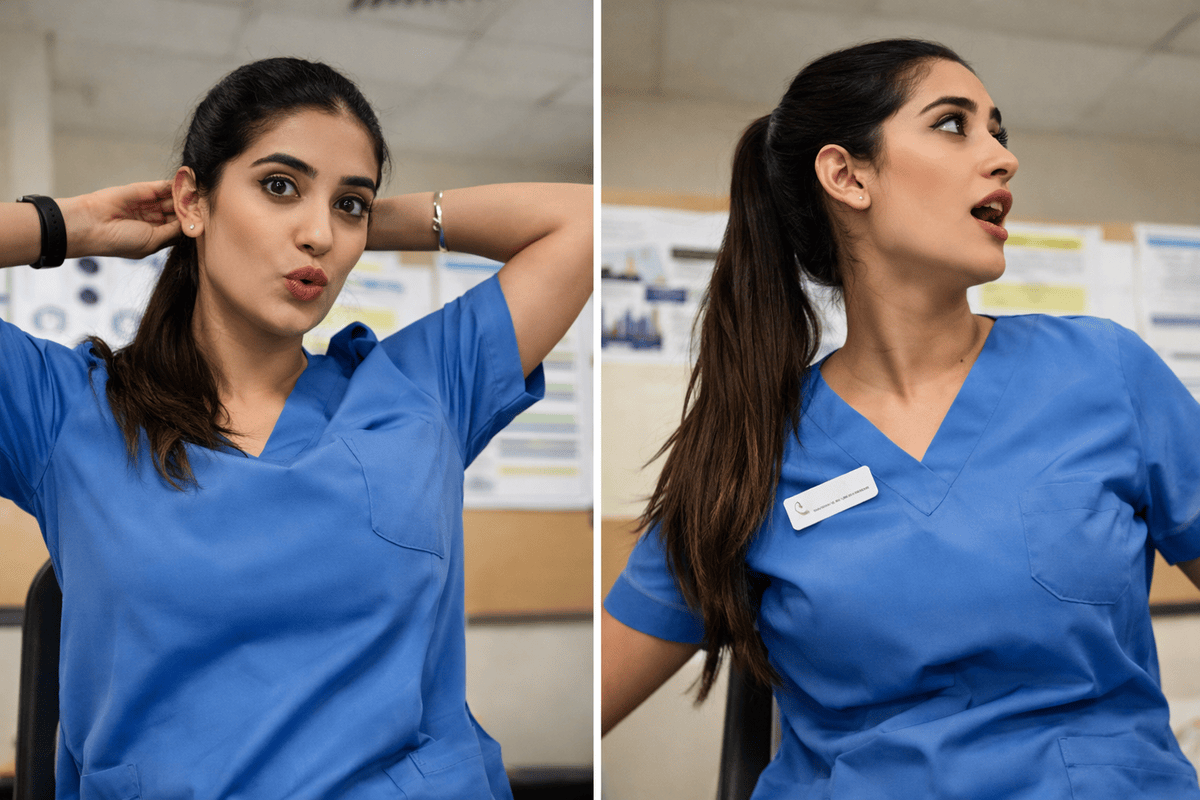
Neha Sharma had waited for this day her entire life.
After years of exams, sleepless nights, and praying that her family’s sacrifices would mean something… she finally walked into Lotus Care Hospital wearing crisp blue scrubs and a brand-new ID badge.
FIRST DAY. FIRST SHIFT. FIRST PATIENTS.
Her hands trembled as she tied her hair back in the staff room mirror.
Not because she was scared of blood.
Not because she doubted herself.
But because she wanted to do one thing more than anything else:
Make a difference.
One of the senior nurses smirked at her nervous excitement.
“First day?” she asked.
Neha nodded, smiling.
The senior nurse sighed.
“Enjoy that smile while it lasts.”
Neha laughed politely.
She had no idea that within a few hours…
that same smile would save two lives.
Her first assignment was simple: general ward rounds.
Check vitals. Assist doctors. Update charts.
Neha walked into Ward 3 and met her first patient—an older man in his late 50s named Mr. Javed Khan.
He didn’t look critical.
He wasn’t screaming. He wasn’t bleeding.
But the moment Neha approached him, he grabbed her wrist.
“Beta… something is wrong,” he whispered.
Neha leaned closer.
“What’s wrong, uncle?”
He pointed weakly at his chest.
“It’s not pain… it’s pressure. Like… someone is sitting on me.”
Neha checked his chart.
The doctors had marked him as stable.
His ECG from the morning was “normal.”
His BP was “acceptable.”
His oxygen levels were “fine.”
A junior doctor passing by glanced at the file and said casually:
“He’s anxious. Give him rest.”
But Neha didn’t move.
She looked at his face.
The sweat on his forehead.
The slight gray tint near his lips.
The way his breathing wasn’t fast… but wrong.
And then she noticed something else.
His fingers were trembling.
Not fear.
Not age.
Low oxygen.
Neha immediately pressed the emergency bell.
The ward staff looked annoyed.
A senior nurse snapped, “Why are you panicking? He’s stable.”
Neha replied calmly, but firmly:
“Uncle is not stable. He is crashing.”
The room went silent.
Neha grabbed an oxygen mask and put it on him herself.
The senior nurse shouted, “Wait for the doctor!”
Neha didn’t.
She checked his pulse again.
It was weak.
His eyes rolled slightly.
And then…
his heart monitor beeped once.
Twice.
Then flatlined.
CODE BLUE.
Chaos erupted.
Doctors ran in. Nurses rushed around.
Someone yelled, “CPR!”
A doctor climbed onto the bed and began compressions.
Neha stood at the side—steady, fast, focused—handing equipment, counting compressions, keeping track of timing like she’d been doing it for years.
The same senior nurse who mocked her earlier now looked pale.
Because everyone realized the truth:
If Neha had waited even one more minute…
this man would’ve died quietly while the staff dismissed him as “anxious.”
After two long rounds of CPR and a defibrillator shock—
his heartbeat returned.
A doctor exhaled sharply.
“He had a silent cardiac event… how did you catch this?”
Neha didn’t smile.
She just said:
“He asked me for help. So I listened.”
Neha’s hands were still shaking from the morning incident when she was assigned to the pediatric wing.
She walked in and saw a young mother sitting beside a 6-year-old girl named Riya.
The child looked sleepy.
Too sleepy.
The mother said, “She’s just tired. She didn’t sleep last night.”
A doctor glanced at the file and said:
“Probably fever weakness. We’ll observe.”
But Neha stepped closer and spoke gently in Hindi.
“Riya… beta, can you look at me?”
The child barely opened her eyes.
Neha checked her lips.
Dry.
She touched her forehead.
Not hot.
But clammy.
Then she saw it.
A tiny swelling near the child’s throat.
Almost invisible.
Neha asked the mother, “Did she eat anything unusual today?”
The mother hesitated.
“Just peanuts… she always eats peanuts.”
Neha’s stomach dropped.
She leaned closer and heard something terrifying:
A faint wheeze.
Not loud enough for panic.
But loud enough for death.
Neha turned sharply and shouted:
“ANAPHYLAXIS! GET EPINEPHRINE NOW!”
The doctor blinked.
“What? No, she’s not—”
Before he finished the sentence…
Riya’s eyes widened.
Her chest tightened.
Her breathing stopped.
She began to turn blue.
The mother screamed.
The room panicked.
A nurse ran for oxygen.
The doctor shouted for a pediatric crash kit.
But Neha didn’t freeze.
She grabbed the emergency injection herself.
The senior staff yelled, “Wait!”
But Neha pushed the epinephrine into the child’s thigh with one clean motion.
Seconds felt like hours.
The mother sobbed uncontrollably.
Then suddenly…
Riya coughed.
Hard.
Her chest rose again.
Her color returned slowly.
She inhaled like she’d been underwater.
And the entire room went silent.
The doctor stared at Neha.
“You… you just saved her.”
Neha’s lips trembled.
Her eyes filled with tears.
She didn’t say anything.
She just hugged the crying mother gently and whispered:
“Ab sab theek hai… ab sab theek hai.”
(It’s okay now… it’s okay.)
By afternoon, Neha’s name was spreading through the corridors.
A first-day nurse.
No ego.
No arrogance.
Just pure instinct and empathy.
One doctor was heard saying:
“She doesn’t work like she’s new… she works like she was born for this.”
Even the senior nurse who mocked her earlier quietly approached her.
“You did good,” she said.
Neha nodded politely.
But her hands still shook.
Because she knew something everyone else didn’t:
She wasn’t brave.
She was terrified.
She just refused to ignore people.
At the end of the shift, the head doctor called her into his office.
“Neha,” he said, “most new nurses focus on procedures. You focused on people.”
Neha looked down.
“I’m sorry if I broke protocol, sir.”
The doctor shook his head.
“You broke protocol… and you saved two lives.”
Neha swallowed hard and said softly:
“Sir… I didn’t save them.”
“I just didn’t treat them like they were a file number.”
That day, Neha walked into the hospital as a new nurse.
By evening…
the entire staff looked at her differently.
Because she proved something most people forget:
Nurses don’t just give injections.
They don’t just change IV lines.
They don’t just assist doctors.
Sometimes…
they are the only reason someone gets a second chance at life.
And Neha Sharma, on her very first day…
left everyone speechless.